• 815-943-4430
  • Emergency Repair
  • Contact
Hartwig Mechanical
  • Commercial
    • HVAC Maintenance
    • HVAC Installation
    • HVAC Repair
    • Plumbing Installation
    • Plumbing Service
    • Building Automation Systems
  • Industrial
    • Industrial HVAC Service & Maintenance
    • Equipment Installation
    • Piping & Welding
    • Pipe Re-Lining Services
  • Design-Build
    • Custom Metal Fabrication
    • Ventilation Systems
  • Industries
        • Manufacturing
        • Multi-Family
        • Healthcare & Medical
        • Education
        • Public Facilities
        • Retail & Hospitality
        • Cold Storage & Processing Plants
  • Areas We Serve
  • About Us
    • Leadership Team
    • Partners
    • Careers
    • Testimonials
  • Blog
  • Menu Menu

Industrial Pipe Lining for Manufacturing Facilities: How to Minimize Downtime

Industrial pipe lining helps manufacturing facilities repair aging or failing process piping without major excavation, which keeps production lines moving and shortens what would otherwise be days of downtime. For plant managers weighing repair options, industrial pipe lining offers a path that protects output, equipment, and the production schedule at the same time.

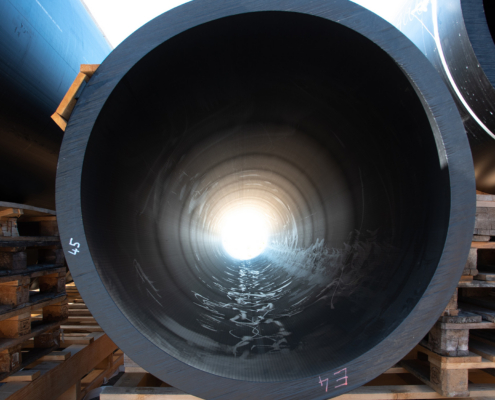
Hollow Large Iron Sewer Pipes

Why Pipe Lining Is the Right Fit for Manufacturing Operations

Traditional pipe replacement is brutal on a manufacturing operation. It requires open trenches, torn-up floors, shutdown utility loops, and crews working in zones that may sit directly under or next to live production. Industrial pipe lining flips that math. By rehabilitating the existing pipe from the inside, your team avoids the demolition entirely.

That is why pipe lining for manufacturing facilities has become a go-to approach in plants running cast iron, galvanized, or older steel piping. Pipe rehabilitation through lining restores structural integrity, smooths the inside wall, and seals leaks without disturbing the surrounding floor, walls, or machinery. The work happens through small access points instead of through excavation. For a plant where every square foot of floor is dedicated to a process, that difference is the entire reason to consider this approach.

The Real Cost of Production Downtime During Pipe Repairs

Most pipe lining content focuses on the cost of the lining itself. That number matters, but it is not the number plant managers actually lose sleep over. The bigger figure is the cost of stopping production while pipes get repaired.

For a mid-sized plant, an unplanned eight-hour shutdown can run into six figures once you stack lost output, idle labor, wasted raw materials in process, missed shipments, and the customer relationships that come under stress when a delivery slips. A weeklong replacement project, even a planned one, multiplies that exposure. Production downtime is the line item that justifies every other decision around how a pipe repair gets handled. Smart plant managers calculate it before they pick a method.

This is where industrial pipe lining changes the math. Because lining work avoids excavation and runs faster than replacement, the production downtime window shrinks dramatically. Combined with planned scheduling around your shift patterns, the disruption can often fit inside an existing maintenance window rather than triggering a separate shutdown or an emergency repair call.

Phased Installation and Bypass Planning Keep Lines Running

Most competitors stop at “lining is fast.” A good contractor goes further by sequencing the work so production never has to fully stop. That sequencing usually involves two tools: phased installation and temporary bypass planning.

Phased installation means tackling the piping system one section at a time, often segment by segment along a single line. While one segment cures, another remains in service. The plant keeps running, and the lining crew keeps progressing. For long horizontal runs or branched systems, phasing turns what could be a full shutdown into a rolling series of brief, predictable handoffs.

Bypass planning is the second half. Before any work starts, the contractor maps which lines feed which processes and where temporary connections can carry flow during the lining cure. In some cases, a portable bypass loop keeps a critical process online while the crew rehabilitates its dedicated pipe. The result is industrial pipe lining work that fits into your operations calendar rather than dictating it.

Trenchless Pipe Repair Minimizes Disruption

The reason phased work is even possible comes down to the trenchless nature of the install. Trenchless pipe repair lets crews access the pipe through small openings rather than digging out the full length, so neighboring equipment, electrical, and structural elements stay untouched. If you want a deeper look at how the process works at a technical level, our overview of what pipe lining is walks through it in detail.

Explore Hartwig Mechanical’s industrial pipe lining services to keep your plant running while your piping gets rebuilt from the inside out.

Find Out More

Material Compatibility for Process Piping in Manufacturing

Process piping in a plant rarely carries plain water. It can move chemicals, condensate, steam, compressed air, slurry, or food-grade product, and the lining material has to match what flows through it. That is why process piping repair through lining always starts with a material compatibility check, not just a condition check.

Two liner types come up most often. CIPP lining (cured-in-place pipe) works well for structural restoration in sewer, drain, and waste lines, while epoxy pipe lining is often the right choice for potable, condensate, and lower-temperature process lines. For older infrastructure, cast iron pipe lining is a specific use case that shows up constantly in plants built before modern materials took over. A good contractor evaluates pipe age, content, temperature, and pressure before recommending a method. The warning signs your facility needs industrial pipe lining often point to which material path fits best.

Prefabrication Reduces Time on Your Floor

Some pipe repair situations call for short sections of replacement piping alongside the lining work. When that happens, prefabrication becomes a major time saver. Instead of building those sections on the plant floor under live production, Hartwig prefabricates them in our off-site shops to exact specifications.

For manufacturing facilities, this matters in two ways. First, the actual onsite work shrinks. Crews arrive with components already cut, welded, fitted, and pressure-tested, so installation goes faster and with fewer surprises. Second, the precision is higher. Shop-built sections come from a controlled environment with the right tooling, which translates to fewer field corrections during install. The lining and any related industrial plumbing repair work end up taking less of your floor’s time and creating less risk of rework. That advantage compounds on larger projects where dozens of components might otherwise be fabricated in the middle of an operating plant, slowing your team and adding risk.

ASME Compliance and Jobsite Safety Standards

Manufacturing clients care about compliance because their own operations depend on it. Any contractor working in your plant needs to operate under the same standards your team does, and that is where ASME pipe lining work separates serious industrial contractors from generic plumbing outfits.

Hartwig’s crews follow ASME and jobsite-specific safety protocols on every industrial pipe lining and industrial piping and welding project. Our welders are trained, certified, and experienced with the kind of pressure piping and process systems that manufacturers depend on. Safety planning starts before the first crew member walks the floor: pre-task hazard analysis, lockout-tagout coordination with your team, PPE compliance, and clear handoffs between shifts. The result is work that not only meets code but also fits the operational and audit standards a plant manager already follows. It is the kind of discipline that keeps inspectors comfortable and your team confident.

Partner With Hartwig Mechanical to Keep Your Plant Running

Hartwig Mechanical has spent decades supporting plants across Northern Illinois and Southern Wisconsin, and our team brings the full mechanical perspective to every industrial pipe lining project. We assess material compatibility, sequence the work around your production calendar, prefabricate what we can off-site, and hold every weld and connection to ASME standards. The goal is the same as yours: keep the line moving while we rebuild the infrastructure underneath it.

If your plant is dealing with aging piping or recurring leaks, contact Hartwig Mechanical today to start mapping a pipe lining plan that fits your operation.

Share This Post

  • Share on Facebook
  • Share on X
  • Share on Pinterest
  • Share on LinkedIn
  • Share on Tumblr
  • Share on Vk
  • Share on Reddit
  • Share by Mail

More Like This

How Industrial Pipe Lining Minimizes Downtime In Busy Facilities

How Industrial Pipe Lining Minimizes Downtime in Busy Facilities

Pipe Lining
https://hartwigmechanical.com/wp-content/uploads/2026/04/How-Industrial-Pipe-Lining-Minimizes-Downtime-in-Busy-Facilities.jpg 1250 2000 Abstrakt Marketing /wp-content/uploads/2025/06/Hartwig_lowres-360w.png Abstrakt Marketing2026-04-28 11:46:392026-06-10 09:56:36How Industrial Pipe Lining Minimizes Downtime in Busy Facilities

Categories

  • Building Automation Systems
  • Commercial
  • Commercial Plumbing
  • HVAC Repair
  • Industrial HVAC
  • Pipe Lining
  • Preventative Maintenance

Location

Rockford, IL (West)
3537 Merchandise Drive
Rockford, IL 61109

Harvard, IL (North)
20800 East Brink Street
Harvard, IL 60033

Mokena, IL (South)

9850 W 190th St,
Mokena, IL 60448

Get In Touch

Phone
(815) 943-4430

Email
Email Us >

Services

Commercial HVAC

Plumbing Services

Industrial HVAC

Design-Build

About Us

Hartwig Mechanical delivers full-scale mechanical solutions with precision, reliability, and rapid response.

Website by Abstrakt Marketing Group ©
  • Sitemap
  • Privacy Policy
Link to: How Building Automation Systems Improve Efficiency in Manufacturing Link to: How Building Automation Systems Improve Efficiency in Manufacturing How Building Automation Systems Improve Efficiency in ManufacturingAdult Electrician Builder Engineer Testing And Screwing Equipment In Fuse Box
Scroll to top Scroll to top Scroll to top

This site uses cookies. By continuing to browse the site, you are agreeing to our use of cookies.

AcceptLearn more

Cookie and Privacy Settings


How we use cookies

We may request cookies to be set on your device. We use cookies to let us know when you visit our websites, how you interact with us, to enrich your user experience, and to customize your relationship with our website.

Click on the different category headings to find out more. You can also change some of your preferences. Note that blocking some types of cookies may impact your experience on our websites and the services we are able to offer.

Essential Website Cookies

These cookies are strictly necessary to provide you with services available through our website and to use some of its features.

Because these cookies are strictly necessary to deliver the website, refusing them will have impact how our site functions. You always can block or delete cookies by changing your browser settings and force blocking all cookies on this website. But this will always prompt you to accept/refuse cookies when revisiting our site.

We fully respect if you want to refuse cookies but to avoid asking you again and again kindly allow us to store a cookie for that. You are free to opt out any time or opt in for other cookies to get a better experience. If you refuse cookies we will remove all set cookies in our domain.

We provide you with a list of stored cookies on your computer in our domain so you can check what we stored. Due to security reasons we are not able to show or modify cookies from other domains. You can check these in your browser security settings.

Other external services

We also use different external services like Google Webfonts, Google Maps, and external Video providers. Since these providers may collect personal data like your IP address we allow you to block them here. Please be aware that this might heavily reduce the functionality and appearance of our site. Changes will take effect once you reload the page.

Google Webfont Settings:

Google Map Settings:

Google reCaptcha Settings:

Vimeo and Youtube video embeds:

Accept settingsHide notification only